
Tools
Tools for seeing what normally remains unseen.
Most of what shapes how we experience life operates in the background — our values, assumptions, preferences, identities and habitual ways of making sense of the world.
These tools are designed to make some of that visible.
They are not personality labels and they are not intended to tell you who you are. They are starting points for inquiry: ways of noticing patterns that can otherwise feel like reality itself.
There are five: the Orientation Compass™, Core Values, the Socratic Method, the Clarity Sequence and THEOS™. No required order — begin wherever the question is live for you.
A mirror, not a label.
A useful model should help you see something — and then become less important once you can see it for yourself.
The aim is not to collect identities, types or frameworks. It is to become more aware of the lens through which you are already looking.
How this fits together
Five tools. One separate method.
The Orientation Compass™, Core Values and the Socratic Method are standalone diagnostics: each one is taken on its own and reveals something that normally stays in the background.
The Clarity Sequence is a repeatable inquiry practice rather than a diagnostic: five dimensions of experience worked through deliberately, then a final question about awareness itself.
THEOS™ — The Human Experience of Self™ — is the fifth: a map of how those forces relate to one another, read from the outside in.
CORE™ is separate again. It is not a diagnostic. It is the method used to work with whatever the tools bring into view, and it runs as a loop rather than a sequence with an end.
01 · Standalone diagnostic
LiveThe Orientation Compass™
Which way are you facing?
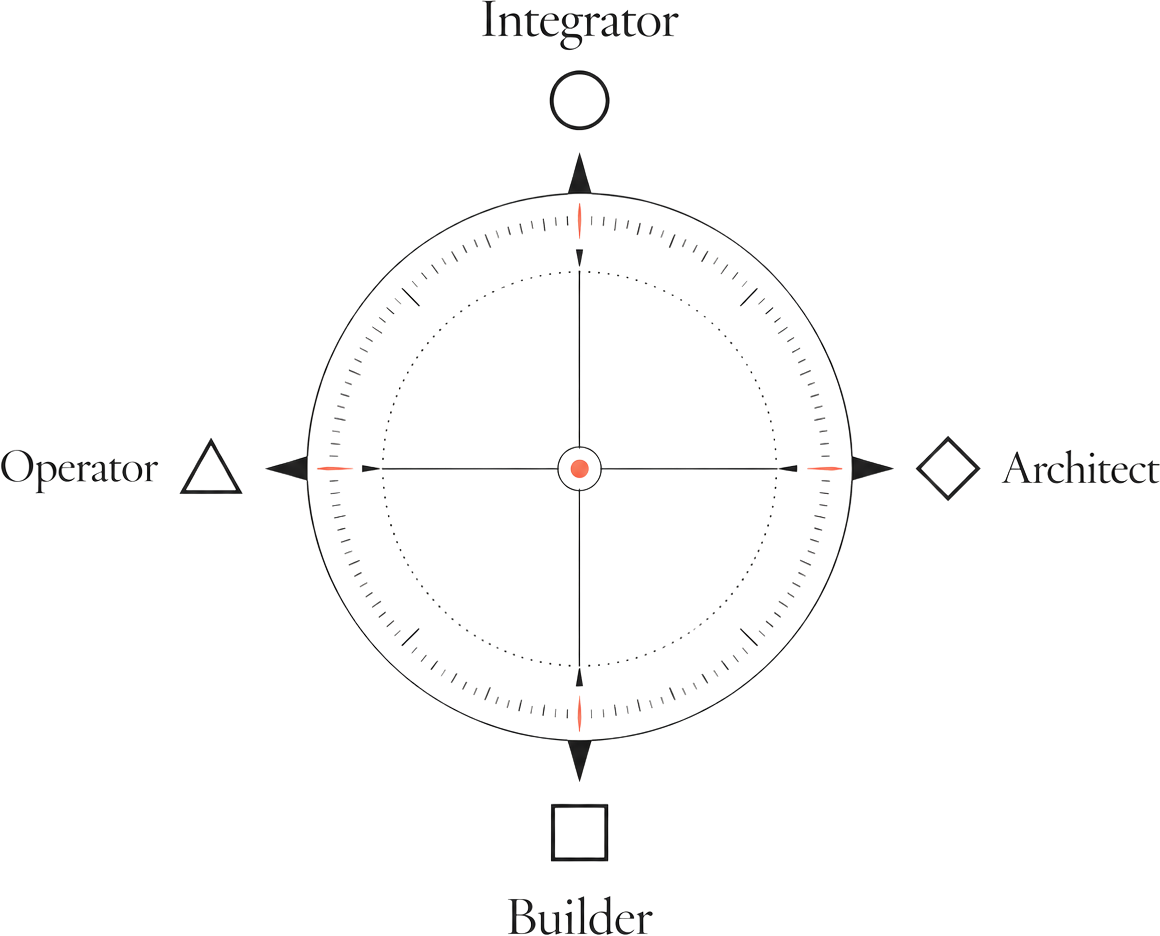
You do not see the whole world at once. None of us do.
We naturally orient toward certain aspects of reality while paying less attention to others. The Compass reads two dimensions: the direction your attention travels, and how tightly you are identified with that way of seeing.
Horizontal orientation
Which way are you facing?
Vertical level · I · D · O · U
How tightly are you identified with the way you see?
An orientation is a preference in attention, not a fixed identity.
02 · Standalone diagnostic
LiveCore Values
What matters to you — and what is actually driving your choices?
The values we say we hold and the values expressed through our behaviour are not always the same.
A standalone diagnostic for examining what you value, where it came from, and how it is quietly shaping your decisions.
03 · Standalone diagnostic
LiveThe Socratic Method
Think like Socrates. Act with clarity.
For overthinking, delay, or circling the same problem: a structured thinking tool that uses disciplined questioning to expose what you are avoiding and what you are assuming.
Seven steps, from Issue to Action, designed to take about 10 minutes — ending with a decision and one concrete step.
04 · Inquiry practice
LiveThe Clarity Sequence
A five-dimensional inquiry for moments when something feels charged, stuck, or unclear.
The Clarity Sequence explores experience through five dimensions drawn from Greek thought — Pathos, Ethos, Logos, Kairos and Telos — then turns attention toward awareness itself.
It is designed to help people separate feeling, identity, meaning, context and purpose so that what was previously fused together becomes visible. A repeatable inquiry practice, used alone or with a partner.
05 · THEOS™
In developmentThe Human Experience of Self™
A map from expression to recognition, read from the outside in.
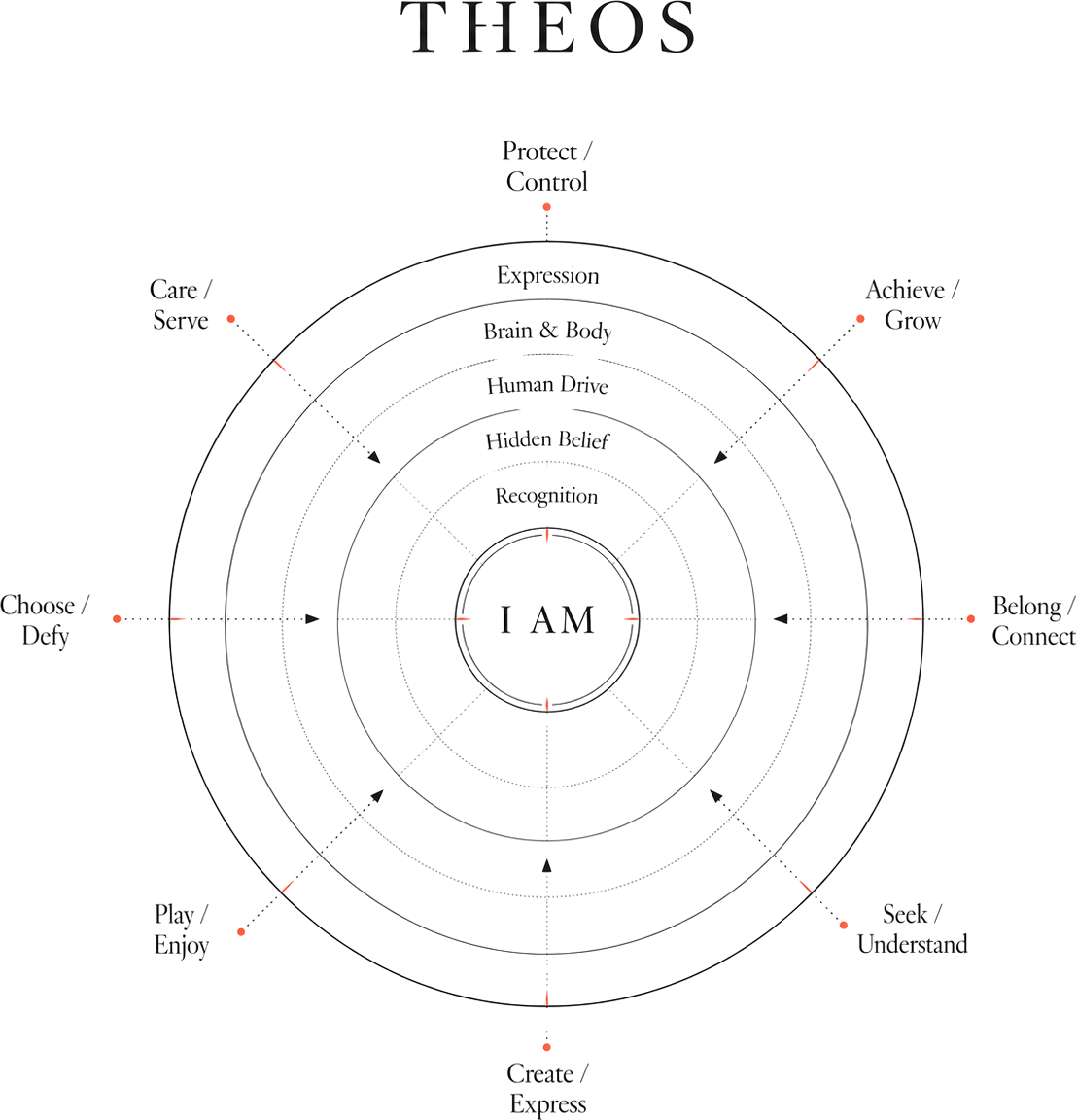
How outward expression, brain and body, human drives, hidden belief and recognition interact to shape our experience of ourselves and the world.
Read from the outside in: what is visible first, what is hidden last.
- 01Expression
- 02Brain & Body
- 03Human Drive
- 04Hidden Belief
- 05Recognition
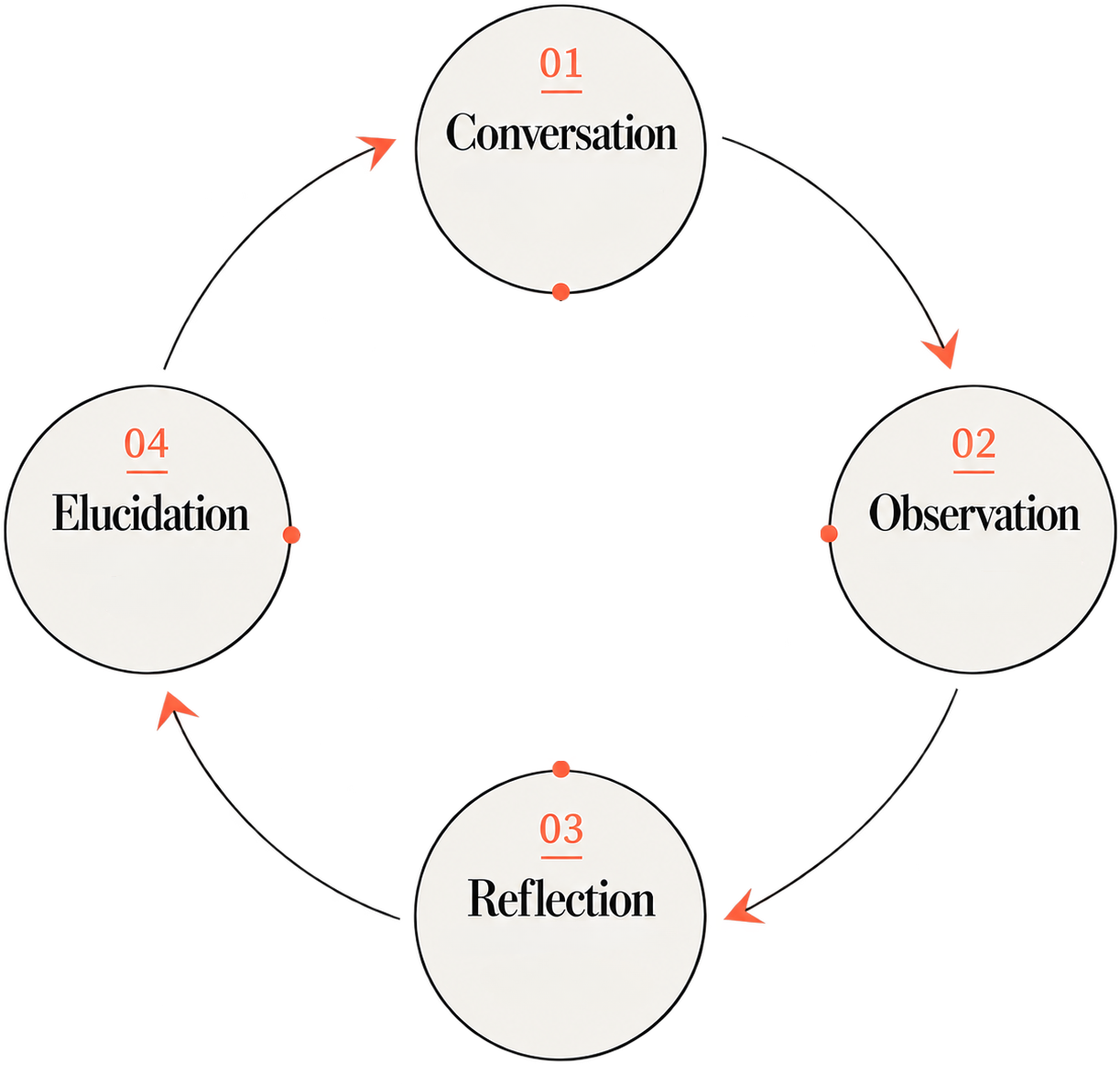
CORE™ is not a diagnostic. It is the process used to work with whatever a diagnostic brings into view, and it circles rather than ends.
It is not coaching, and it is not an attempt to fix, correct, optimise or improve the person. Its purpose is to create and hold the conditions in which clearer seeing can occur. Through careful attention, listening and inquiry, a conversation can reveal what advice usually obscures.
The premise is simple. What a person sees for themselves tends to hold, while what is handed to them from outside tends to fade. CORE™ therefore assumes that discernment and a workable sense of direction are already present in the person, however obscured, and that the task of a conversation is to make that available rather than to replace it with someone else's conclusion.
Whether this happens in Recover the Signal, The Council, another shared setting or one to one, the role is not to supply the answer or manufacture the breakthrough. The quality of attention and dialogue is what allows recognition, insight or a genuine shift in perspective to emerge from the person, or from the room itself — which is why the work is to stay with the inquiry long enough for that to happen.
- CConversation
- OObservation
- RReflection
- EElucidation
- back to Conversation
Conversation → Observation → Reflection → Elucidation → Conversation
Elucidation does not end the process — what becomes clear opens the next conversation.
How to use these tools
Use the tool. Notice the pattern. Then look beyond the tool.
Every framework simplifies reality. That is what makes it useful — and what makes it dangerous if we mistake the map for the territory.
Use these tools to notice something you could not previously see. Test what they reveal against your lived experience. Keep what is useful. Let go of what is not.
The destination is not better models.
It is clearer seeing.
Seeing is only the beginning.
The tools can reveal a pattern. Recover the Signal creates a guided 21-day cohort for staying with what you discover and putting it into practice.
Want to experience the work live? The Conversation is a free session every two weeks: one idea, one hour, then the room opens.